

Costa Rica Property Taxes for Foreigners in 2026: Rates, Exemptions, and Real Numbers

Updated: Oct 1
Municipal property tax is 0.25% of the registered value. The trap is that a registered sale resets that base to your purchase price automatically. So if you buy at $600,000, your bill is about $1,500/year from the first year — not the $900 the seller was paying on a stale $360,000 declared value. Do not let an agent quote you the seller's current tax bill as if it will be yours. Registered values do lag market value across the country, but that lag belongs to owners who have held without transacting; it does not survive your closing. Foreigners pay the same rate as Costa Rican citizens - no surcharge, no foreign-owner penalty. The bigger story isn't the rate, though; it's the capital gains rules, the luxury tax, and the personal-name-vs-corporation decision that most guides skip - and that's where you either save or burn tens of thousands.
Last updated: July 2026
I've been a buyer's agent down here since 2020. The single biggest sticker-shock moment I see with my clients isn't bad - it's the relief on their faces when they finally read their first Costa Rica property tax bill and compare it to what they were paying in New Jersey or Ontario.
One of my clients in Uvita bought at around $400K. His annual property tax is about $1,000. He used to pay $11,000 a year on a smaller house in Connecticut. He laughed out loud when the bill arrived. That's the real headline here - not whether the system is complicated, but how cheap it is once you understand it.
Let me walk you through every layer.
Do People Pay Property Taxes In Costa Rica?

Yes. Every property owner - foreign or local - pays an annual property tax of 0.25% of the registered (assessed) value to their local municipality. That's a quarter of one percent. A $400,000 assessed home runs about $1,000/year. A $600,000 home you have just purchased, about $1,500/year. A $1M assessed home, about $2,500/year.
You pay it once a year (or in quarterly installments if you prefer) directly to the municipality where the property sits. Most municipalities now accept online payment through a Costa Rican bank, and your accountant can handle it on autopilot for $50-100.
There's no escrowed-into-your-mortgage system like in the US. You're responsible for paying it yourself, on time. Miss it and you'll rack up interest and penalties - not catastrophic, but annoying.
How Registered Value Works - And Why Your Purchase Resets It

Here's the part nobody else explains clearly.
The 0.25% rate is applied to the registered value at the municipality. Here is what that means for you as a buyer: a registered sale sets that value to your purchase price. The day your deed is recorded, your base is what you paid. Nobody gets to hand you the seller's old number.
My own house shows you both sides of this. It would ask around $850,000 today, my registered value sits well below that, and my annual property tax bill comes to roughly $350. That's a real number, on a real property, in 2026. It is also a number you cannot buy your way into. I have held without selling, and that is the only reason it exists. The day that house transacts, the new owner's base resets to what they pay and the bill goes to roughly $2,100.
Why the gap? Reassessments don't happen every year, and Costa Rica's municipalities have nowhere near the staffing of a US county assessor's office. Registered values do lag market value across the country, but that lag belongs to owners who have held without transacting; it does not survive your closing. You're also legally required to declare your property value every five years, and after a purchase that declaration starts from what you paid.
So when you're modeling carrying costs on a property, use 0.25% of purchase price as your real number, not your worst case. If someone tells you to budget half that, they are quoting you a bill that died at the seller's closing table.
The Solidarity (Luxury) Tax: Does It Apply To Your Property?
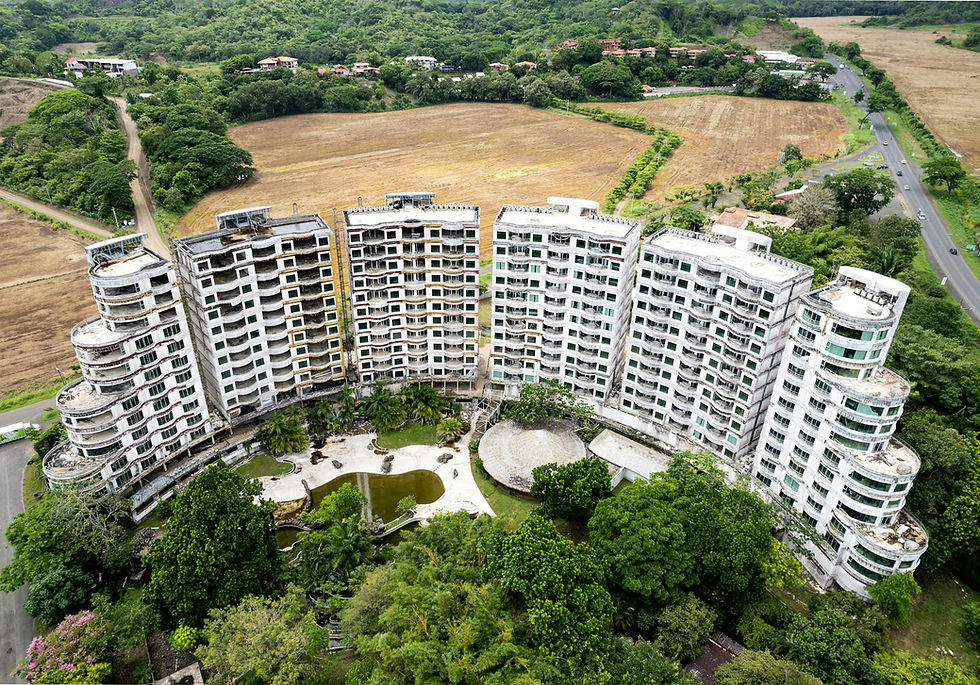
There's a second property tax called the Impuesto Solidario - the luxury or solidarity tax. The 2026 exempt threshold is ₡143,000,000 of construction value — roughly US$316,000 at about ₡455 to the dollar. Here is the part almost everyone gets wrong: construction value alone decides whether you owe the tax, but once you cross the threshold, the land value is added to the taxable base. So a $320,000 build sitting on a $400,000 lot is not taxed on $320,000 — it is taxed on $720,000. Rates run 0.25% up to ₡359M and step up through 0.30%, 0.35%, 0.40%, 0.45% and 0.50% to 0.55% above ₡2,162M. You self-declare on Form D-174 and the deadline is 15 January. It applies whether you hold the property in your own name or through an S.A., an S.R.L. or a trust, so the corporation does not shelter you from this one. The threshold is reset by decree each December, Decreto 45358-H set the 2026 figure, so check the current number before you file.
If your construction value is under the threshold, you pay zero solidarity tax. Plenty of what I help clients buy in the South Pacific in the $400-700K range lands under it because the lot carries a big share of the value. Don't assume, though. Get the build value broken out on paper before you sign, because a $700K property with a $350K house on it is over the line, and then the land gets pulled into the base behind it.
If you're buying a luxury build - think the $1.6M+ homes coming online in the new Dominical development, or anything in Peninsula Papagayo — the solidarity tax applies on a sliding scale starting at 0.25% and stepping up to 0.55% on the highest tier. You file and pay it separately on Form D-174 by 15 January.
Talk to a licensed Costa Rican accountant about whether your specific build crosses the line. The official threshold gets published annually by Hacienda, the Costa Rican tax authority.
Transfer Tax And Closing Costs When You Buy
This is the line item that catches buyers off-guard, so let's lay it out clean.
Cost at Closing | Amount | Who Pays |
|---|---|---|
Transfer tax (to National Registry) | 1.5% of purchase price | Buyer |
Notary / legal fees | ~1.5% of purchase price | Buyer |
Stamps and registration fees | Bundled into notary | Buyer |
Total closing costs | ~3% of purchase price | Buyer |
On a $500,000 purchase, you're looking at roughly $15,000 in closing costs, on top of the purchase price. On a $300,000 entry-level home in Uvita, about $9,000.
Up until about five years ago, closing costs were split 50/50 between buyer and seller. That's shifted. Nine times out of ten now, the buyer covers it. You can still negotiate a 50/50 split into your offer - and we go to bat for you on that - but don't assume it.
One more thing: sign on the very last line of every document at closing. If your lawyer asks you to sign a line or two down, refuse. That gap creates space for fraudulent insertions. I've seen lawyers go to jail in this country for exactly that kind of move. Use a vetted attorney - and if you don't have one, that's something we help with.
If you want to see what's actually for sale right now in the ranges I keep referencing, browse current listings here and then book a call and we'll run real numbers on whatever catches your eye. One thing to keep in mind while you browse: Costa Rica has no MLS and no public record of closed sales, so every price you see anywhere is an asking price, not evidence of what anything sold for.
Capital Gains Tax On Costa Rica Property - And The Primary-Residence Exemption
Here's where the real money lives.
Costa Rica's capital gains tax is 15% on profit. There is a primary-residence exemption under Article 28 bis, but it is narrower than most people are told. It applies only to an individual who is tax-domiciled in Costa Rica and can document that the property was their habitual residence — utility bills, municipal receipts, migration records. Living there a year is not by itself the test. If the property sits in an S.A. or S.R.L., the corporation owns it rather than you, and the exemption is generally unavailable. If you are not tax-domiciled here, the buyer's notary withholds 2.5% of the total consideration and that withholding is a final and definitive tax, not a credit you reconcile later (Resolution MH-DGT-RES-0039-2025, in force 6 October 2025). Domiciled sellers see 2% withheld on account. And if you do this repeatedly, Hacienda can reclassify the gains as business income taxed at up to 25% for individuals and 30% for companies under the habitualidad rules. Get a Costa Rican tax accountant on this before you list, not after.
One alternative most foreign sellers never hear about: if you acquired the property before 1 July 2019, you may elect to pay 2.25% of the gross sale price instead of 15% on the gain. It applies to the first sale of that asset only. On a long-held, heavily appreciated property this is usually far cheaper than 15% of profit — run both numbers.
Let me give you a real example from my own neighborhood.
My neighbor bought a 3-bedroom home for $650,000. Two years later, family reasons forced her back to North America. She listed and sold for $1,050,000 - a $400,000 gain. Because she held title in her own name, was tax-domiciled in Costa Rica, and could put utility bills and municipal receipts on the table to prove she actually lived there, she qualified for the exemption. None of that was automatic. Time in the house was not what got her there. Documented habitual residence by a tax-domiciled individual was. The same sale through an S.A. or S.R.L. would have been taxed, and holding through a corporation is how most foreign buyers here take title.
On top of that, the casita on her property had been renting for $2,500/month the entire time she lived there. That rent wasn't free money - 13% IVA came out of the advertised price and 12.75% of gross went to Hacienda under Rentas de Capital - but two years of it plus a $400K exit with no capital gains bill is still the math people miss.
What the exemption actually requires:
An individual (persona física) on title. Not an S.A., not an S.R.L., not a trust
That individual has to be tax-domiciled in Costa Rica
You have to be able to document habitual residence: utility bills in your name, municipal receipts, migration records. Keep them from day one, because you cannot manufacture them the week you list
Only one property is your habitual residence at a time. Sell more than one in the same window and the rest are taxed at 15% on the gain
Do it repeatedly and you lose it. Once Hacienda sees habitualidad in your property dealings, the gains stop being capital gains and get taxed as ordinary business income, up to 25% for individuals and 30% for companies
If you're a real estate investor flipping multiple properties or holding rentals, the 15% applies, and if the pattern is obvious enough you land on the business-income rates instead. And no, you cannot compound gains tax-free by living in each house for a year and trading up. That is the most expensive piece of bad advice circulating in the expat groups down here. The exemption is for the home you actually live in, documented, once. It is not a strategy you run on repeat.
Buying In Your Name Vs A Costa Rican Corporation: Tax Implications
This is the question I get most from US and Canadian buyers, and a lot of guides barely touch it.
Personal name (your passport):
You keep the primary-residence capital gains exemption on the table, provided you're tax-domiciled here and can document that you live in the place
Cleaner, cheaper to set up - no annual corporate tax, no RTBF filing
Simpler when you eventually sell or pass it on
My general advice: if it's your home and you're buying one property, hold it in your passport
Costa Rican corporation (SRL or SA):
Annual corporation tax of roughly $120-400/year depending on activity, due 31 January. Leave it unpaid three years running and the company gets dissolved with your house inside it
The RTBF beneficial-ownership declaration, filed every year in April. This is the one people forget. Miss it and the penalty is 2% of gross revenue, and the Registry blocks any document being recorded in the company's name. That freezes a sale in the middle of the transaction, which is a brutal way to find out you're behind on paperwork
Circular DPJ-002-2026 did away with the simple carta-poder. If you're signing corporate paperwork from outside the country you now need a notarial power of attorney, apostilled
Asset protection - shields the property from personal liability
Useful if you're buying multiple properties or running a business
Useful for some US/Canadian tax structuring strategies
You lose the primary-residence capital gains exemption because the corporation owns it, not you
For most people relocating, buying one home to live in: passport name, keep the capital gains exemption available to you, keep it simple. For investors buying three or more income properties: corporation structure, accept the trade-off, and put the RTBF filing in your calendar every April. Talk to a licensed Costa Rican accountant about your specific situation before you sign anything.
Rental Income Taxes And IVA If You Short-Term Rent Your Property
If you Airbnb your casita or your whole property, you're running a business in the eyes of Costa Rica.
You owe:
Register with ICT (Costa Rican Tourism Institute). Under Ley 9742 this is mandatory for short-term rentals, not a nice-to-have
13% IVA (value-added tax). By law the IVA has to be included in the price you advertise, so you don't add it on top at checkout — it comes out of your gross at 13/113. Filed monthly, not quarterly
Income tax is where people get caught. If you own one rental property you are taxed under Rentas de Capital at 12.75% of GROSS rent — not net, and no deductions for your mortgage, your management company or your repairs. There is no exempt band on that. To be taxed on net profit you have to be treated as a business, which in practice means employing at least one CCSS-registered employee. Add a municipal patente of 0.15% to 0.30% of gross. Hold it in a company and there's no relief either: companies are taxed from the first colón of profit. And from 2026 Airbnb reports host earnings directly to Hacienda. Between 13% IVA, 12.75% Rentas de Capital and the patente, you're losing roughly 26% of gross before you've paid a single bill, so any yield number that skips the tax stack is fiction.
Monthly filings through Hacienda's online system (entirely in Spanish)
Penalties for missed filings start around $300 and scale up fast. Don't try to DIY this - most Costa Rican citizens use an accountant for exactly this reason. Budget $50–100/month per rental property for a Costa Rican accountant to handle the filings.
If you want a feel for the broader monthly cost picture before getting into rental operations, my breakdown of the hidden costs of moving to Costa Rica lays out what most newcomers miss.
Do US Citizens Living In Costa Rica Pay Taxes?
Yes - to the US, always, no matter where you live. The US taxes citizens on worldwide income. Costa Rica residency doesn't change that.
What you still owe Uncle Sam:
Annual 1040 filing
FBAR if your foreign accounts exceed $10,000 aggregate at any point in the year
FATCA Form 8938 if foreign assets exceed the threshold
Foreign Earned Income Exclusion — caps around $130K (verify the current year with your accountant)
Foreign Tax Credit for any Costa Rican income tax you've paid
What Costa Rica does not tax you on: foreign-source income. If your paycheck comes from a US employer or US clients, Costa Rica doesn't touch it. That's the territorial tax system, and it's one of the genuine reasons people move here.
Canadians: different ballgame. You can sever residency ties with Canada to stop being taxed there, but it requires actually severing - selling your home, moving family, closing most accounts, triggering deemed disposition. Get a licensed international tax accountant before you do anything irreversible.
Authoritative sources for current US obligations: IRS guidance on FBAR and the US State Department's Costa Rica information page.
What Is The 183 Day Rule In Costa Rica?
The 183-day rule determines tax residency. If you're physically present in Costa Rica for more than 183 days in a calendar year, Costa Rica considers you a tax resident - meaning you may owe Costa Rican income tax on Costa Rica-source income, and you're subject to local filing rules.
Foreign-source income is still not taxed under Costa Rica's territorial system, even if you hit 183 days. So a US remote worker living here 250 days a year, getting paid by US clients into a US bank account, owes Costa Rica nothing on that income.
Where it matters: if you're earning Costa Rica-source income (rental income, a local business, local consulting), the 183-day threshold pulls you into local progressive tax rates of 10–25%. It also matters when you sell, because tax domicile is what separates a 2% withholding on account from a 2.5% withholding that is final.
If you're planning serious time on the ground, you may want to look at one of the five residency categories - Pensionado, Rentista, Inversionista, Vínculo, or Digital Nomad - rather than living on tourist stamps.
Can I Live On $2000 A Month In Costa Rica?
Honestly? Tight, but doable in the right area. My three-tier framework:
Modest tier (~$2,000/month): Inland, smaller-town living. San Isidro or Pérez Zeledón. Local food, local services, modest housing. Doable.
Comfortable tier (~$3,000/month): Most expat households land here. Decent rental in a popular area, eating out a few times a week, mid-range car.
Premium tier ($5,000+/month): Beach town, nice house, full lifestyle, pickleball, gym, restaurants. Add international school tuition if you have kids.
So $2,000/month puts you between modest and comfortable - fine in Atenas, San Isidro, or a smaller inland town. Tough in Tamarindo, Manuel Antonio, or Uvita coastal. If you have school-age kids, international school tuition alone can eat half that budget per child. Budget your colón conversions at the bank window, not the headline rate: the BCCR reference is around ₡449–455 and the banks sell dollars at ₡459–461.
And one of the biggest unlocks: even at a $500K purchase, property financing for US and Canadian buyers now runs 25% down at 7–10% over 30 years - which means your monthly housing math looks very different than paying cash.
Final Word
Costa Rica's property tax system is genuinely one of the best things about owning here - but only if you go in with the right numbers. The 0.25% annual rate is easy, and it applies to what you paid, from year one. The capital gains exemption and how narrow it really is, the corporation-vs-personal-name decision and the RTBF filing that comes with it, the IVA and Rentas de Capital math if you rent - those are where I see people either save serious money or leave it on the table.
I'm a buyer's agent, not a seller's agent, and I'm the only Open Inventory buyer's agent in Costa Rica. That means I don't hold listings - I work for you, on every property in the country. If you want to run the actual tax math on a specific property before you make an offer, book a call and let's dig in. Pura vida.
By Mark Savoia — buyer's agent in Costa Rica since 2020
I've spent 12+ years in Costa Rica, the last five full-time, after 25 years as a home builder in Canada. My team has helped move over $1.4B in client assets into Costa Rica, and 7,000+ readers get the Playbook every week. I don't hold listings - I work for buyers, on every property in the country. Book a call and let's figure out your numbers.
Related guides: Costa Rica land for sale · Costa Rica buyer's agent


Comments